Saturday, February 27, 2016

Friday, February 26, 2016
LCM AND GCF
Factor
When a whole number is divided into
another whole number without a remainder, it is called a factor.
Factors are either composite numbers or prime
numbers (except that 0 and 1 are neither prime nor composite).

Example:
The
number 6 is a factor 54, because it goes into 54 evenly 9 times. In this case 9
is also a factor of 54.
Example:2 and 3 are factors of 6,because 2 × 3 = 6.
Example:3
is a factors of 9, because 3 × 3 = 9.
Note:
Prime numbers only have 2 factors: 1 and itself
Prime
Factors
All factors of a number that are prime are called prime factors.
Prime
Factorization
The Prime Factorization of a number is written as the product of all its prime factors.
Common
Factor
A common factor is a whole number that is a factor of
two or more nonzero whole numbers.

Example:
3 is a common factor of the numbers 15 and 24. Both 15 and 24 have 3 as a
factor, therefore 3 is called “common” between 15 and 24.
Greatest
Common Factor
The greatest common factor, or GCF, is the greatest
factor that divides two numbers.
Different
methods to find GCF
There are 3 methods for finding the GCF.
1 Method 1. Rainbow method
Example: Find the GCF of
14, 35.
List all the factors
14:
1,
2, 7,
14
35:
1,
5, 7,
35
Common
factors: 1, 7
GCF:
7
Method 2. Factor Tree method
 Example: Find the GCF of
18, 24
Example: Find the GCF of
18, 24
step 1: List all the factors using factor tree
18 = 2x3x3, 24 = 2x2x2x3
step 2: Identify the common factors
The common factors of 18 and 24 are 2 and 3.
Step 3: Multiply the common factors to find the GCF.
GCF = 3x2 = 6
Method 3. CAKE
or ladder Method

Step 1:
Divide the numbers by the prime number until the numbers cannot be divided evenly
Step 2:
Multiply all prime numbers used to divide.
Multiple
The multiple, x, of a number, n, is a number where n
is a factor of x.
Example:
The number 33 (x) can be divided by 3 (n) without any remainder. So 33 is
a multiple of 3 (3 * 11 = 33).
Common multiple
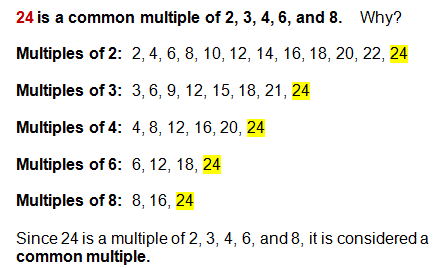
A common multiple is a number that is a multiple of two or more numbers. The common multiples of 3 and 4 are 12, 24, 36...
Least common
multiple (LCM)
The least common
multiple (LCM) is the smallest number that is a
multiple of two or more numbers.
Example: The
LCM of 2, 3, 4, and 6 is 12.
Different
methods to find LCM
Method 1: Listing Multiples
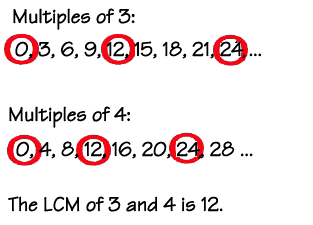
Find LCM of 3 and 4
Step 1:
List all multiples of 3 and 4
Step 2:
find common multiples
Step 3:
Find least common multiple
Method 2: Using Prime Factorization

Step 1:
Identify Common factors
common factors for 18 and 24 are 3 and 2
step 2:
Multiply common factors with all other factors
Other factors for 18 is 3 , other factors for 24 are 2 and 2
Step 3:
Multiply the common factors with other factors
LCM = 2x3x3x2x2= 72
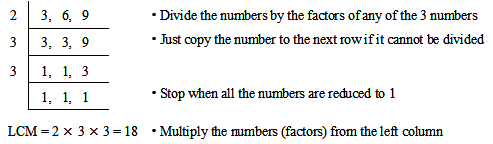
Method 3: ladder method
Relationship
between the GCF and LCM
The product of the GCF and the LCM of two or more
numbers is equal to the product of the numbers:
GCF (a, b) · LCM (a, b) = a · b
LCM (a,b) is read as "LCM of numbers a and b"
GCF (a,b)
is read as "GCF of numbers a and b"
Example:
GCF (12, 16) = 4
LCM (12, 16) = 48
48 · 4 = 12 ·16
192 = 192
Thursday, February 18, 2016
Pythagorean Theorem
The Pythagorean Theorem
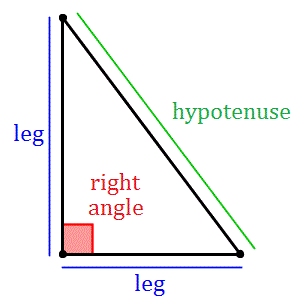
states that when the squares of sides a and b on a right triangle are added up,
it equals the square of side c, the hypotenuse of the triangle.

It is more commonly
known as
a2 + b2 =
c2.
(a and
b are legs or sides and c is the hypotenuse)
When each of the sides
of a right triangle has a whole number length, the three numbers are called a
Pythagorean triple.
Some of the Pythagorean
triples are listed below:
(3,4,5) (5,12,13)
(7,24,25) (8,15,17) (9,40,41) (11,60,61) (12,35,37) (13,84,85) (16,63,65) (20,21,29)
(28,45,53) (33,56,65) (36,77,85) (39,80,89) (48,55,73) (65,72,97)
Triangles and Angles
Types
of Triangle
- Equilateral triangle: Has 3 sides of equal length and three equal angles (Always 60 degrees).
- Equiangular Triangle: All three angles are equal.
- Isosceles triangle: Has 2 sides of equal length and two equal angles.
- Scalene triangle: Has no sides of equal length and no equal angles.
- Acute triangle: All angles are less than 90 degrees
- Right triangle: One angle are 90 degrees.
- Obtuse triangle: One angle is more than 90 degrees.

Types of Angles
- Acute Angle: An angle less than 90 degrees
- Obtuse Angle: An angle more than 90 degrees but less than 180 degrees
- Right Angle: An angle equaling 90 degrees
- Straight Angle: An angle equaling 180 degrees
- Reflex Angle: An angle more than 180 degrees but less than 360 degrees
- Interior Angle: The three angles on the inside of a triangleExterior Angle: The angle between a side of a triangle and the extension of an adjacent side.

A triangle can be more than one type at the same time.
For example:
- A scalene triangle can have one interior angle 90 degrees, (making it also a right triangle) and is called a "right scalene triangle"
- An isosceles triangle has a right angle is called a "right isosceles triangle"
Formula for Perimeter of a Triangle:
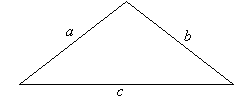
The
perimeter is the distance around the edge of the triangle.
Perimeter
= A+B+C
Formula for Area of a triangle
The
area is half of the base times height.
Area =1/2bh or A=bh/2

|
Facts
1.
A
triangle has three sides and three angles.
2.
The
three angles always add to 180 degree.
3.
The sum of the lengths of any two sides of
a triangle is always longer than the third side.

4.
The longest side of a right angle triangle
is called the hypotenuse, it is always found opposite the right angle.
5. The shortest side is always opposite the smallest interior angle
6.
The longest side is always opposite the largest interior angle.
7.
The interior angles of
a triangle always add up to 180°
8.
The exterior angles of
a triangle always add up to 360°
|
Thursday, February 11, 2016
Subscribe to:
Comments (Atom)